
Minglewood Band – Can’t You See
For music lovers of my generation living in Cape Breton, Nova Scotia, there may not have been a more important artist than Minglewood Band. While there were other bands in the area experiencing varying degrees of success – I remember Road (we owned the 45 of “Song for Noel”) and Sam Moon, among others, getting a fair bit of local radio play – Minglewood were the band that stood out, not only for their crisp country-tinged blues rock sound that played equally well in high school gyms, church halls and bars, but also for the fact that someone outside the Maritimes was paying attention: they earned a Juno nomination for most promising group in 1980.
But I have a slightly more personal attachment: every time I hear one of their songs, I think about the night that one of my closest friends stole my prom date.
Calvin Hood and Doug Maxwell were both a year ahead of me in school, as were several others in my circle of friends, and I really wanted to celebrate their prom with them. I was, however, as per my usual high school status, very single, and not exactly gifted with the skill set needed to end that. Calvin’s solution was to have me escort his sister Nadine, who was several years older than me and out of school already, but more importantly a super sweet girl who I was thrilled to have the chance to awkwardly (because awkwardly is how I rolled back then) hang out with. We would go on to become really close friends, and I spent as much time socializing with her as anyone over the next year or so before I headed off to university. But first we had to get through June 1981 and prom.
(This might be a good time to point out that I wasn’t entirely without swagger, as this photo taken that night will hopefully prove:
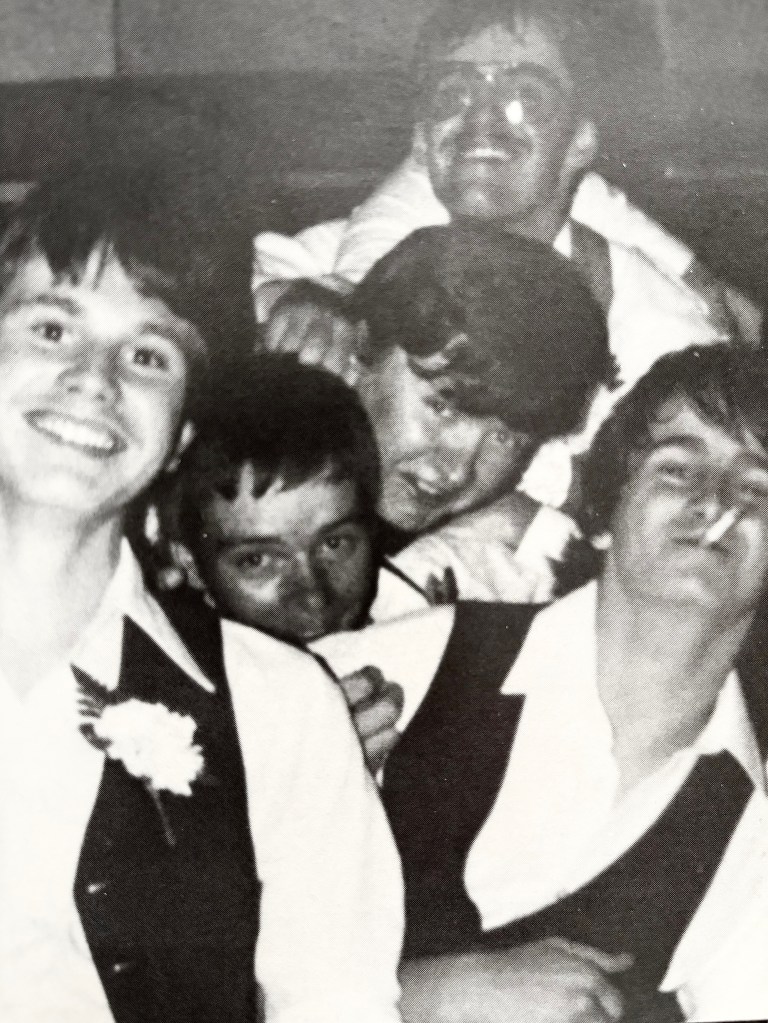
That’s me at the bottom right, with Doug at the top and Calvin directly below him, Robert Garnier on the left and Steve Horton in the middle fighting for breath.) (See! These people that I write about are real!)
And then there was Doug, who was also at prom with a friend who was not a potential romantic partner. And Doug fell hard for Nadine.
Doug knew there was nothing romantic going on between me and my date (as I recall, Steve was the only one in our crowd who was at prom with his actual girlfriend), but he was ever a gentleman and a righteous dude. Prom ended, and we retired to a small gathering at our pal Darrell Clarke’s house, where we ate lobster that I had procured earlier that day, impressing my friends by attacking the little creatures with such gusto that crustacean juice was splashing everyone at the table. We also became progressively drunker, and at some point Doug and I ended up alone when I found him waiting in the hallway as I exited the upper floor washroom. (Yes, it was a setup.) Leaning close in like conspiratorial stupid boys will do in such cases, he told me he had a crush on my date. This wasn’t out of character for Doug: of all my friends of that era, he was probably the most heart-on-his-sleeve type. I affirmed his belief that I was not a barrier to him acting on those feelings, and we parted.
Having been third-wheeled by my pal, I ended up at the stereo, where Minglewood Band’s self-titled 1979 album was playing. And for the rest of the night bleeding into sunrise, I did three things. I would travel to the fridge for another drink. I would flip the album over to the other side. And I would lie on the floor drinking beer and listening to Minglewood Band.
The truth was, I had never been much of a fan. I hadn’t seen them live at that point (that came a few years later, and they were pretty awesome). I was a committed top 40 kid in an era when – and I am surprised now to be reminded of this – Styx and REO Speedwagon spent four painful months moving in and out of the top spot on the best selling albums chart. Minglewood did not play the kind of music I was listening to. But there is something about being 16, hammered out of your ever-loving mind and filled with the glow of having done a solid for a friend that can bind you to the music of that moment, and that was Minglewood, and especially “Can’t You See”.
What’s amazing about “Can’t You See” is that they turned it from a southern rock classic (I didn’t know until years later that it was a cover of a Marshall Tucker Band record) into a tune that is as Cape Breton as pogey, cod fishing and bagpipes. The key lies in the narrative that frontman Matt Minglewood reels out at the beginning: the tale of a small town boy in the big city whose life is falling apart but he just can’t bear the thought of heading back home a failure. Leaving and coming back no better off than you left – whether materially or personally – is the classic Cape Breton journey. Succeeding means staying away, whether it’s for weeks at a time, or years. When my children were relocating to Cape Breton after their mother and I split up, my Ontario friends said I shouldn’t let them go, that they needed to see me all the time. I wasn’t concerned. My father was a fisherman, and he’d be away weeks at a time in summer. Some friends had it worse (or better?), with fathers off in Ontario for month-long turns on the boats that worked the Great Lakes, or longer as they toiled in the oil fields of Alberta or the frozen north. Absent fathers is the Cape Breton way, and I had turned out fine, right?
It’s a gentle opening, subtly evoking the loneliness of the open country, then a mournful guitar kicks in. Matt starts talking at 51 seconds, and right away tells you that “this is definitely a song about loneliness”. In two minutes, before singing even one of Toy Caldwell’s words, he spins the classic East Coaster’s tale of success and failure in the big city, culminating in the dread of “that long anxious walk down that short corridor” that soon leads to him waiting for a train to God only knows where at 4:00 a.m., wanting home but feeling like he can’t go back there, not now, not like this. When he starts to sing, all the pain and anguish of lost love and the migrant’s feeling of dislocation comes through, of feeling that no one would care if you just disappeared. There’s tinkly piano, tear-jerker harmonica and keyboard, and over it all is Matt, leaving every emotion, every bit of himself, in the grooves. The final minute is a tour de force of duelling instruments, conveying the confusion in the young man’s soul. And it ends where it began – with the small town boy going back home. A song of the south was never more poignant than when in the hands of a bunch of Cape Bretoners.
As for other higher profile cover versions, The Charlie Daniels Band do a good job, but without quite the same depth as Minglewood, and my second favourite version might be from Black Stone Cherry, who dispense with the sentimentality and turn it into a howling rallying cry for a beaten down man. Hank Williams Jr.’s version is too loose, Waylon Jennings’ too mannered, Gary Stewart’s an abomination (this song is not a romp!). Many versions are too up-tempo, as if not trusting the pathos at the song’s heart. Minglewood Band didn’t miss that, and if they skirt the line of becoming maudlin, they don’t cross it. Maybe I only feel that way because the song is personal to me, to my experience, but what’s the point of making and enjoying art if that doesn’t happen?
Doug and Nadine dated for a few years, but their destinies lay elsewhere. I eventually reconnected with both for a time over Facebook, but those kinds of relationships aren’t real and can’t last. Doug is gone now, and it seems he remained a stand-up guy to the end, which would surprise no one who ever met him. I’ve been listening to “Can’t You See” on repeat and feeling sad over Doug, but in the end, the song is about a triumph, about having a home to return to even when you are at your lowest. If you’re from Cape Breton (or anywhere that you call home, really), you understand what that means. And if you’re not, you should go there anyway. As my wife could tell you, you’ll be warmly welcomed by people like Doug: decent, honourable and a good hang – even when they’re stealing your date.
 PopNotes