One Hit Wonderment #4

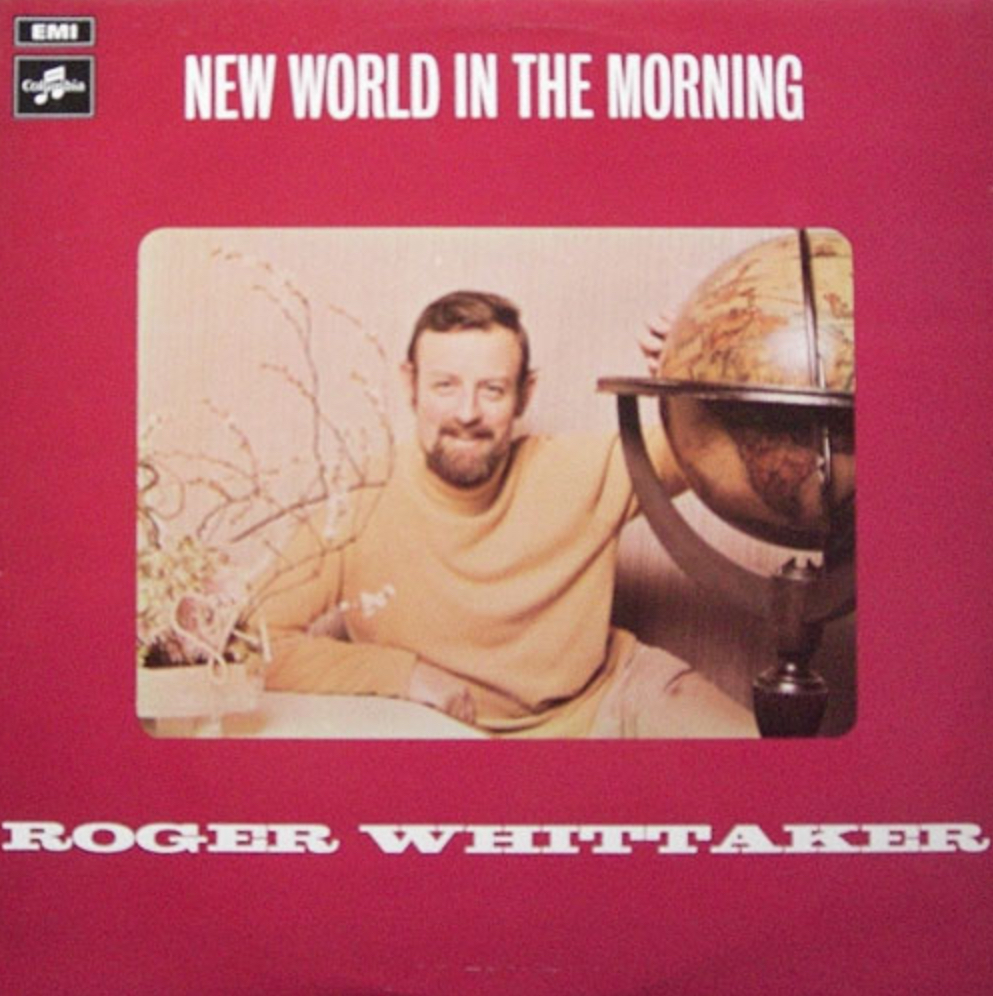
Roger Whittaker – The Last Farewell

Any successful relationship almost certainly requires that the participants change. It’s just simple logic: if all people are unique – and I believe we are – then the work of fitting your life into your partner’s and vice versa means, at a minimum, that there will be edges to be planed down. Or maybe it’s more about appearances, like applying a fresh coat of paint, or something more substantive, like ripping out the plumbing or adding a room. (Can you tell we’re going through a renovation right now?) Whether it’s a job that a Tim Taylor can handle, or if you really need an Al Borland, what matters is that the work gets done.

Of course, this applies to all unsuccessful relationships, too. And that is how I ended up at a Roger Whittaker show circa 1991/1992.

Fandom doesn’t really have age categories. While we probably think of the fans of Sir Tom Jones as ladies in their golden years, a work colleague who is probably (a gentleman never asks) not yet or at most barely 30 somewhat sheepishly professed her love for the silver Welshman to me when admitting that she was accompanying her mother to his show for her own reasons. So it is no comment on my 12 years older then-girlfriend’s musical tastes when she dragged 26/27 year old me to the Whittaker show. Except, of course, that it is.

I heard Whittaker on the radio a lot while growing up, so I was surprised to see he’d only had a single song hit the Billboard top 40. As it turned out, while he had multiple chart hits in the United Kingdom, Ireland and the Netherlands, Canada may have been his biggest market. In 1982, he even charted a song called “Canada Is” in a classic bit of sucking up to the already converted. He had only two “pop” hits here, but between 1970 and 1990, no less than 18 songs reached the top 20 of the adult contemporary chart, including two #1s. But not “The Last Farewell”, which peaked at #3 on the AC chart, as well as at #9 on the pop chart. But its chart performance doesn’t really tell the story of “The Last Farewell”: with roughly 11 million physical copies sold worldwide, the 45 is in very lofty company. Also at that number is a song from Cher, but more impressive is the next group in the 10 million range: Bing Crosby, George Harrison, Elvis Presley, The Monkees, Toni Braxton, ABBA, Paul Anka, Britney Spears, Procol Harum and, umm, “My Sharona” by The Knack.

I don’t remember much about the show. It was at Massey Hall, so the audience was well-behaved and quite elegant, at least by my standards of the time. Everyone remained seated throughout – it was more like going to the theatre than a concert. I recognized an awful lot of the songs, as if I needed more proof that Whitaker had been a big part of my subconscious aural life. And I had a reasonably good time – Whittaker was an amiable and relaxed performer, and the dude could whistle, a skill which never fails to impress me since I am, sadly, most inept when it comes to turning that part of my body into a musical instrument. (Drumming on pretty much any bit of my anatomy that I can reach is a different story.) His whistling was one of the things my girlfriend had been looking forward to – she was actually excited about it – and he did not disappoint.

On listening to “The Last Farewell” now, I was initially sort of boggled by how well the song did until I looked at the rest of the top 20 from its peak week of June 21, 1975. It fits in rather comfortably with a lot of the tunes ahead of it: Michael (Martin) Murphey’s “Wildfire”, Jesse Colter’s “I’m Not Lisa”, “Sister Golden Hair” by America, John Denver’s “Thank God I’m A Country Boy” and “I’ll Play For You” from Seals & Crofts. And radio playlists of that era always had room for the occasional folkie, no matter how truly old fashioned his style might be. Whittaker was probably fine with that – he just kept doing his thing for close to another 40 years.

As for this record, well, I just cannot connect with it in any way. I never paid attention to the verses, so I didn’t know that it’s about a sailor who heads into battle and, even as the possible end of his days looms darkly, he is remembering the great love of his life, and dreaming of the day when he returns to her. The lyrics – written by a silversmith who sent them to Whittaker for a radio contest – are quite poignant, but the whole thing is made unbearably mawkish by the music. It begins with an orchestral swell, before settling down to sappy strings, gently strummed guitar, tinny piano and poser martial horns. A few piano keys struck at the 31-second mark are a lovely note, but the rest is just a bombastic overproduced mush of sound with nothing distinctive about it, save for Whittaker’s warm vocal. Done live, and possibly off the cuff, without the orchestra or a faux attempt to recreate one, it’s just a whole lot more palatable to these ears.

Whittaker retired around 2012, and took that retirement seriously: he didn’t release any music nor, as best I can determine, perform publicly in the last decade of his life. But musicians never really stop making music, and he was still touting his continuing whistling ability in late 2014. He passed away in September 2023, aged 87. I hope he went out whistling.
One-Hit Wonderment #3

Judson Spence – Yeah, Yeah, Yeah

If writing this blog has demonstrated one thing to me, it’s that pretty much every song I ever loved or record I ever bought has a story behind it. It might not be a story in which I look cool or even decent, like buying Van Halen’s “1984” as a beard so that people wouldn’t think I was gay – yep, that’s the word that my 20-year-old male mind conjured up – for buying Wham’s “Make It Big”. I might even come off as pathetic (we’ll get to one of those eventually – unless my “1984” story counts). I might not even realize what the story is until I start writing about it. But it’s there.

For example, I became a Judson Spence fan because I could not resist the lure of free stuff.

There was a stretch in the mid to late 1980s when I spent such a disproportionate share of my take-home income on music and music adjacent products and activities that there should have been an intervention. Without giving away too much, my average weekly spend would be the equivalent in 2023 dollars of $200 to $250, which is insane. It was sort of an investment, since when I reached a particularly low point in the summer of 1988 and was forced to sell some of my albums in order to eat, I got two weeks worth of groceries out of one trip to the local used record store. (Goodbye, pristine copy of Led Zeppelin’s “In Through the Out Door”, among other gems.)

A few months later, in early October 1988, I relocated to Toronto from St. Catharines and found an exponential increase in music buying possibilities, though the cost of living and lack of a safety net (St. Catharines had lots of people who were happy to feed me and generally watch out for me, and I ran away to Toronto to free myself from their strangling embrace) led me to temper my profligacy. But I would still journey downtown every Saturday morning to walk around the record (and book) stores, travelling north with my finds in mid afternoon to my basement room in a boarding house.

It was on an autumn 1988 Saturday, possibly my second in the city, that I noticed concert tickets sitting on the counter near the cash register at one such record store. I learned from the clerk that they were free, all for mid-week shows being sponsored by some record label to promote a new act. I didn’t know who any of the artists were, and thought it would be greedy to take more than one pair, so I pretty much randomly decided to go with Judson Spence, who at least sounded normal.

My date for the show was my friend Chris, who hadn’t heard of him either but had nothing better to do that night. It was a completely platonic date – we had once tried the real thing just to see what might happen, which turned out to be nothing (attraction can’t be faked, and she at least was smart enough to pretend afterwards that the date had never happened). I don’t remember much about the show, other than we didn’t know any of the songs yet still had a great time. Great enough that on the following Saturday, I bought the cassette, and played it many, many times over the next few years.

Although I have not listened to Spence’s music for a very long time, a few lines from his song “Attitude” have claimed a permanent space in my brain: “The lawyers all grin / As she makes her way in / Like a scene from a movie” and “Falling apart at the seams / My heart gets the message she’s sending” have often been conjured up out of the ether. Neither is a particularly original line, but that again is one of the mysteries of music. Like when I played “Yeah, Yeah, Yeah” for the first time in what has to be at least 25 years, and quickly had a sort of muscle memory, of jumping up and down with Chris in a crowd of more or less equally unknowing people, just caught up in the flow of the sounds and his energy as a performer, and the lyrics quickly started coming back to me so that on the second play I could sing along (to my cats’ chagrin) for almost the entire song. It’s a bouncy tune, trying to be funky but just too white bread to pull it off. It aims for the feel of a rocking gospel tune, with church organ and finger-picked bass, but it’s gospel lite at best. What it really is is a pretty good example of uptempo late 1980s’ blue-eyed soul (the real giveaway is when he adds in saxophone, the official instrument of “someone’s getting laid tonight” of the era), maybe with some sloppy urban thievery, and the whole album would fit nicely on your Hall & Oates or Steve Winwood playlist. I happened to love those guys in the 1980s, so Spence’s record was right in my wheelhouse.

Spence, like a lot of artists, probably didn’t have the career he wanted. “Yeah, Yeah, Yeah” peaked at #32, and that was the end. As best I can tell, he’s managed to release four albums over the past 35 years, only two of which are on Spotify or Apple. He’s still active – he released two singles in 2022, and I can’t say I liked either of them, but that’s just how it is with music: all my faves have music I dislike (or actively hate – cough, “We Didn’t Start the Fire”, cough). I don’t know what else is going on in Judson’s life, but I hope everything has worked out, because his first record gave me a lot of joy in 1988 and the next few years after, and again with relistening to it now. For free, as it was in the beginning.

One-Hit Wonderment #2

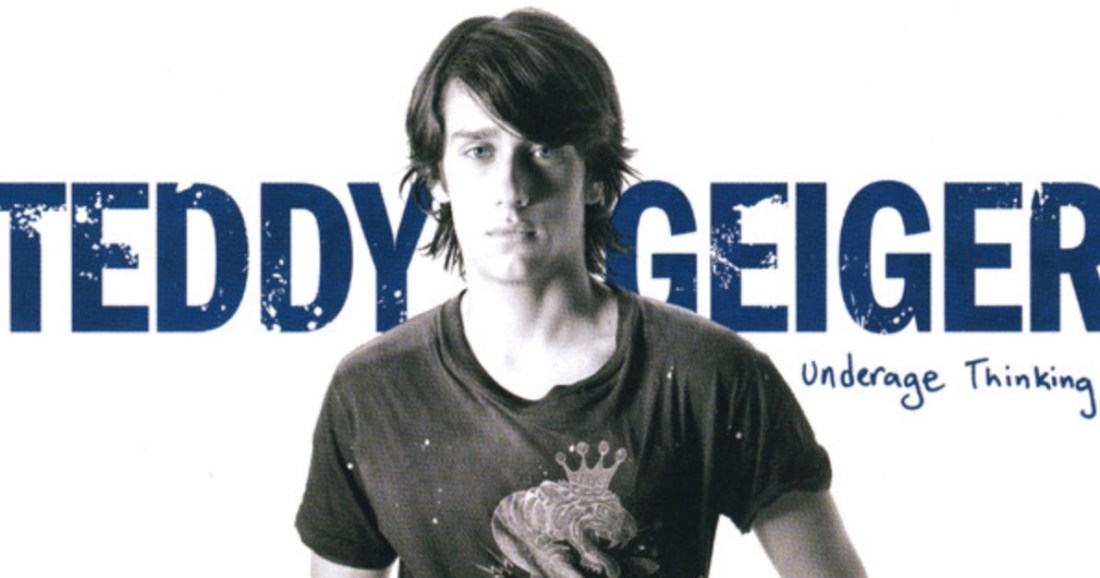
Teddy Geiger – For You I Will (Confidence)

I’m a dedicated Spotify user, but it isn’t without its issues. Certainly, a lot of artists are screwed by the payment model, but artists being abused by the industry side of “music industry” is hardly a new phenomenon. More bothersome to me personally (yes, because that’s what counts) are the murky dealings that lead to songs entering and exiting the massive database of available tracks. Sometimes they might have a prolific artist’s entire catalogue (Van Morrison comes to mind) but for an album or two. Or a song you love might just show up one day on a playlist when it wasn’t there before (“Flagpole Sitta” by Harvey Danger, which I had been actively seeking on a regular basis). Or, in the case of Teddy Geiger’s “For You I Will (Confidence)”, a song I had on two of my own playlist creations, you might not even notice it’s gone until you go looking for it.

I have no recall of how the song came into my life, only that it caught my attention and never really lost it. On my old iPod is a version downloaded from LimeWire that differs from the single, and which I prefer. I love this song so much that I put it forward in 2011 to my fiancé as one of the possibilities for our first dance together as husband and wife. We ended up going with Ben Folds’ “The Luckiest” (I could do a whole series on what Folds’ music has meant to my life), Steve Earle’s “Valentine’s Day” found a place somewhere in the festivities, and “Linus and Lucy” marked our exit. I’ve never been to a wedding with cooler ceremony music than my own.

Geiger was something of a teen idol but there was a secret under this: Geiger had long known she was really female in a male body. She came out as trans in 2017, and carries on her life now as Teresa while still being Teddy in her career, releasing music as recently as October 2021. It’s also a bit of a cheat to call Geiger a one-hit wonder, since she has moved heavily into writing and production, working with such acts as One Direction, Maroon 5 and, most notably, Shawn Mendes, with the hits “Stitches”, “Mercy” (my two favourite Mendes tunes), and many others.

There’s no easy way to explain why the song still gets me in the feels. It’s about taking a risk for a chance at love, about diving in and having faith that everything will work out. I love the sort of echoey and bubbly feel with the slightly tinny guitars during the intro. I love how the verses suddenly explode with pent up emotion then drop low again before a colossal drum run into the chorus. I love the break after the second verse where Geiger states things she would do to get the girl’s attention. I love the way she sings “But I’ve got to try” in the last chorus. I love that a pop song uses the word “muster”. (That can’t be too common, right?) I love the romantic belief that everything will work out fine if you just commit

The music video is a classic of teen movie cliches. Shots of Geiger looking with longing at her dream girl – Kristin Cavallari of “Laguna Beach” fame – intertwined with Kristin’s obviously douchey and unworthy boyfriend (who reminds me of Derek, Justin Long’s competition for the love of Julie Gonzalo in “Dodgeball: A True Underdog Story”) are intercut with Geiger in her home recording studio. It moves then to a pool party where Geiger takes that leap of faith she’s been singing about and gets to kiss the girl (bewildered Derek stands by with his red Solo cup, the universal label of young male douchery), who wakes up on a couch in that home studio, smiling at Geiger as she puts the finishing touches on the song she just wrote about them coming together as a couple.

Yes, it sounds cheesy, but I’ve never thought that meant something had to be bad: cheese as a food is as good as it gets! Sometimes we think things are cheesy because they’re too familiar, too direct, too emotional. But maybe that just makes them universal, too: most of us have known that feeling of wanting to be with someone who doesn’t see us that way. I listened to this song a lot in late 2007 and early 2008 as my world was falling apart and I felt completely unloved, and again later in 2008 when life was rapidly becoming better than I had ever thought possible. Maybe that’s why it still hits me hard even now: it feels like my own story was being told, that I was the one cannonballing into the water.

One-Hit Wonderment #1

The Singing Nun – Dominique

What makes a hit song? There are people who are paid a lot of money to figure this out and they are as clueless as the rest of us. For proof, I offer two (well, three) examples. 

In 1983, Sheriff hit #61 on Billboard with “When I’m With You”. A most modest success, it was soon relegated to the last spot on stripper set lists. Five years later, it was resurrected by a Las Vegas disc jockey (one wonders where he was spending his off hours), rereleased as a single and went to . Or take Billy Vera & the Beaters, whose “At This Moment” stalled at #79 in 1981. Ignored even by strippers after that, it also became a hit five years later when it was featured prominently on an episode of “Family Ties”. The point? Timing has a lot to do with whether or not a song “pops”. (A pop culture tie-in helps: see also Bush, Kate).

Second (or third) example. History records “Passionfruit” as the second single from Drake’s 2017 mixtape “More Life”. But what I remember in real time is that his label was pushing another song but fans weren’t having it so they had to pivot to support the listeners’ choice. The point? You can’t make people like stuff.

I mention this because it leads into one of my favourite things in music: the one-hit wonder. These are the most unpredictable of musical treats, since no one has the goal of having but one popular song. The artist captures the cultural moment – or at least part of it – with a song that can’t be denied, then is returned to where they were, maybe a little richer, maybe heartbroken by the failure to stay on top, maybe just thrilled to have had that moment. The songs that got them there might be all-time classics (The Penguins’ “Earth Angel”), craven attempts to capitalize on a trend (Buckner & Garcia’s “Pac-Man Fever”), novelties (“They’re Coming to Take Me Away, Ha-Haaa!” by Napoleon XIV), viral sensations (Tay Zonday’s “Chocolate Rain”, which actually never charted, because Billboard had no idea what to do with YouTube streams in 2007), or earnest efforts that end up being just weird enough to stand out (“Dominique” by The Singing Nun). Or they might just be good songs.

The definition of what makes an act a one-hit wonder is so subjective that it can defy reason and even simple math. Case in point: Simple Minds. In early 1985, after several acclaimed albums but no hit singles in North America, they reached with “(Don’t You) Forget About Me”. For a lot of people, it seems their career ended there, which ignores that their very next single, “Alive & Kicking”, reached #3 less than a year later. Somehow, because people are too dim to continue listening to the latter song, which is damned good if not the former’s equal, the band has this label. WTF?

In my eyes, to be a one-hit wonder you must (1) have a song make the Billboard top 40 and (2) never have another song get even a whiff of the top 100. That leaves out a band like A-Ha, who followed up their “Take On Me” with another top 20 single just five months later (plus had a long and successful career outside North America). Nor should it include actors who briefly steer into music, like Anna Kendrick (#6 with “Cups” in 2013), or side projects from established stars/band member stars turned solo stars (both too many to mention), or artists with great careers that were not built on having pop hits (Bobby McFerrin already had five Grammys before any of us had ever heard “Don’t Worry, Be Happy”). So, yes, my standard is subjective as well, but it sure as hell would never include an artist with two top 3 hits in one 12-month period. That’s just stupid.

In the end, one-hit wonders are just fun to listen to (usually) and read and write about, and there are hundreds (I’ve been making a list) of them to remember, and celebrate. I mean, what’s not to love about a singing nun. She’s a nun! Who sings! Count me in.

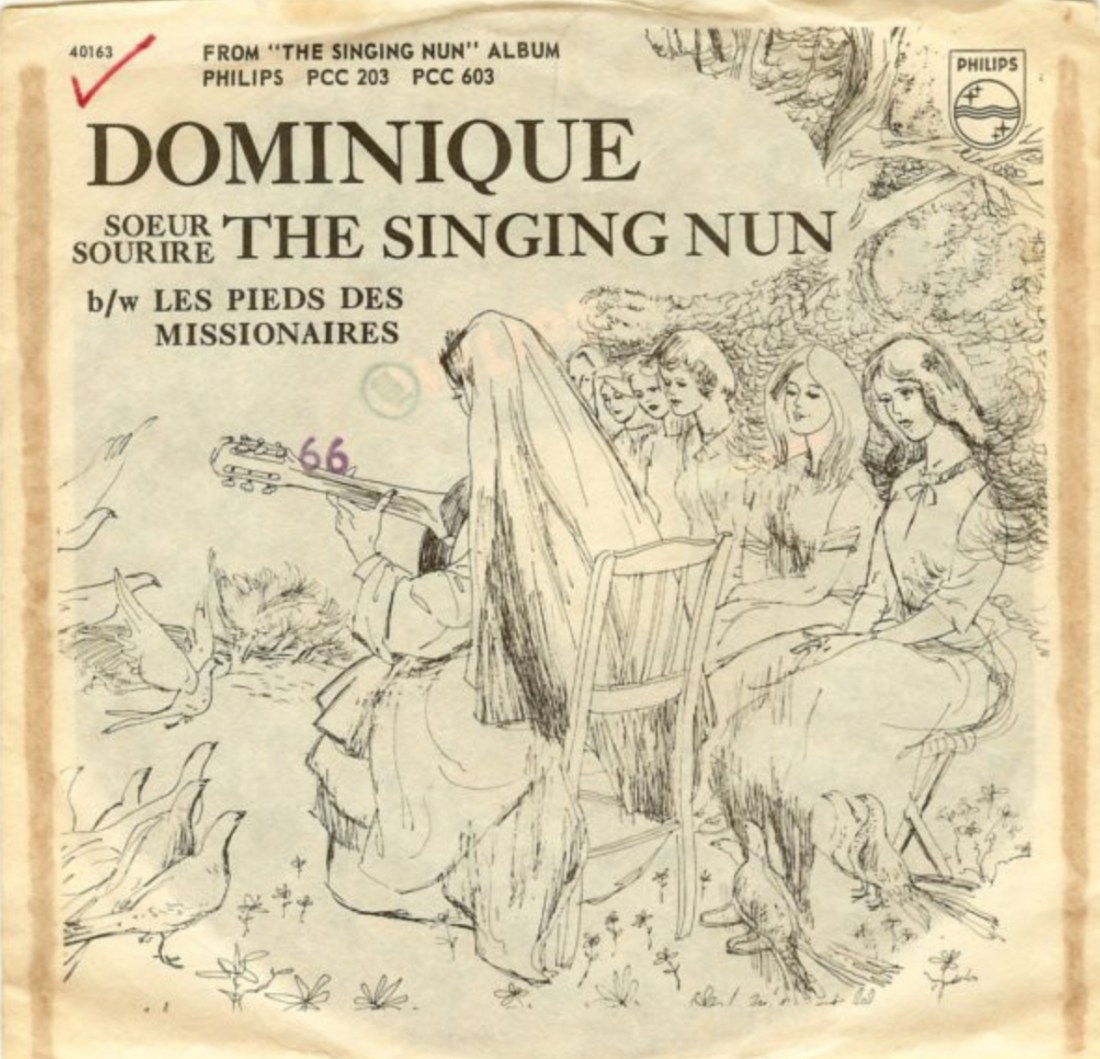
So, about that. Not only was Jeannine Deckers an actual nun, but her song is about a saint, which has to make it one of the most Catholic songs to ever chart (and thus kind of appealing to a reformed Catholic like myself). Her story is sad in so many ways: she was screwed out of most of the profits from her surprise hit (a pretty common occurrence), was forced out of her beloved Dominican order followed by the Church interfering at times as she tried to establish a singing career, was possibly a closeted lesbian, and, ultimately, ended her own life (as did her purported life partner) at a far too young age. A pretty glum back story to a very cheery tune.

It’s a rather simple song – unless my ears are missing something, guitar is the only instrument – with a straightforward verse/chorus/repeat until nauseated format. Deckers is joined by what my mind imagines to be a small chorus of other nuns, in austere black behind her glowing white habit, palms pressed together as they look heavenward and Jeannine strums away. It’s also far from original: this Spike Jones mashup with “When the Saints Go Marching In” shows that in pretty awesome fashion.

Most importantly, it’s another one of those songs that makes me wonder WT actual F was in people’s minds when masses of them said “I want to own that record” in late 1963. Enough of them said it that it spent all of December at , which boggles the mind. The more you listen to it, you can almost talk yourself into seeing why people loved it so (unless they were pioneering hate buys, like the later Sanjaya voters or many viewers of “Emily in Paris”): it has a bouncy energy that gives the endorphins a boost. Or maybe it was just the times, since 1963 was a year when none of the following classics topped the charts: “Be My Baby”, “Louie Louie”, “Blowin’ in the Wind”, “Ring of Fire”, “Surfin’ U.S.A.”. Instead, a lot of weeks they had the likes of Bobby Vinton, Steve Lawrence and “Deep Purple” to choose from. “Dominique” may have been an unexpected joy in musically dark times. That’s how I like to see it.

Luckily, The Beatles were coming to change that.