
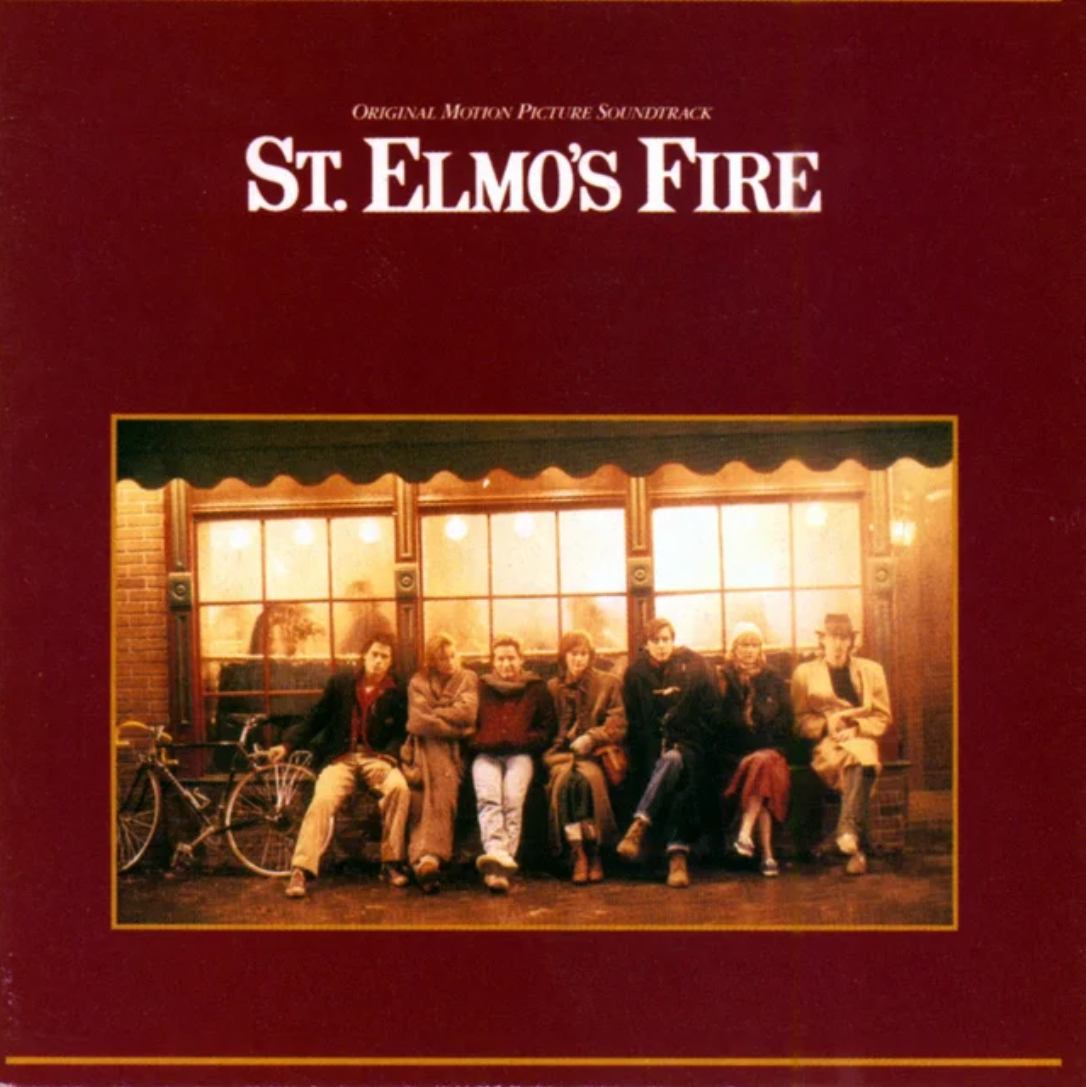
John Parr – St. Elmo’s Fire (Man in Motion)
I think that the artists and entertainers that we form an attachment to at a critical stage in our lives never stop being important to us. That has to be the case, because it’s the only way I can find to explain my lifelong interest in the career of Andrew McCarthy.
In the 1980s, I saw, relative to the total count of movies I attended and the small tally of those he appeared in, a disproportionate number of films starring McCarthy. “Class”, “Heaven Help Us”, “St. Elmo’s Fire”, “Pretty in Pink”, “Mannequin”, “Weekend at Bernie’s”: for all but the first of these, I laid down a part of my limited cash in exchange for the privilege of watching McCarthy act – sometimes poorly (sorry, Andrew!) – in some often fairly awful but always entertaining films. Why? Because something about McCarthy – or at least the characters he played – appealed to me. He seemed like an outsider to the Brat Pack (confirmed in his recent memoir about that era), and therefore more relatable. Who else was a young wanna be novelist going to identify with but the fairly normal looking actor playing a young wanna be novelist saying overwrought things about art and life in a film about trying to get your shit together after university? The rest of the male “St. Elmo’s Fire” cast couldn’t fit that part: Emilio Estevez was too much a try-hard, Judd Nelson was either intimidating (“The Breakfast Club”) or a dick (“St. Elmo’s Fire”), and Rob Lowe was (is!) too painfully beautiful for mere mortals such as I to look to as a model for living. Which left McCarthy.
If you’ve forgotten the film, then you are blessed. My friends and I made fun of it even when we were watching it pretty much every week on First Choice. Since it isn’t on any of the 38 streaming services that I pay for and I didn’t feel like laying out another $4.99 to torture myself, I checked out some of the available clips on YouTube, and it was every bit the overwritten and overacted horror show that I remembered. It’s like Strindberg or Ibsen as interpreted by 12-year-olds, all drama without depth of feeling. There is casual racism (the single minority character of note is a stereotyped Black streetwalker) and a disdainful mockery of outsiders. Maybe accurate for the world of baby yuppies that it purports to show, but hardly a fun day at the movies.
And yet, at 21, I loved it even while knowing what bullshit it was. McCarthy’s Kevin was who I wanted to be. I wanted to be that clever, that attractive (a reachable goal, I thought, before “Pretty in Pink” turned him, ever so briefly, into a heartthrob), and, as he is by the end of the film, a published writer. Plus, I would get to sleep with Ally Sheedy in her super-cute phase. Not a shabby life, really.
I don’t recall where in the film the song shows up, but its synthy pop-rock sound and extremely generic lyrical content don’t match the movie’s vibe at all. That isn’t John Parr’s fault: he hadn’t seen the movie, so co-writer David Foster showed him some video of CanCon superstar Rick Hansen’s world tour via wheelchair for inspiration. The ridiculous music video showing Parr interacting with the actors in character at the burned-out bar that serves as their hangout in the film (their decision to stop going there at the movie’s end is supposed to signal to the viewer that they are now adults) has nothing to do with the film’s narrative. It sounds like a bunch of other songs that were popular in the first half of the 1980s, and somehow – likely thanks to the boost from the movie – jumped past those songs to reach #1. I owned the 45 and played it frequently, finding the overall positivity of the song to be aspirational and inspirational. But before now, I can’t remember the last time I played it with intent. After a few plays, each of which left me with that old pumped-up feeling, I still can’t see it breaking into my nostalgia rotation.
Anyway, despite wanting to model myself on McCarthy’s character, that wasn’t who I was, and Kevin’s future wasn’t my future, or McCarthy’s. And as I have travelled through life, I have periodically checked in to see what McCarthy was up to. His acting career seemed like a wasteland for a long time, but I knew he ended up as a successful television director. His memoir filled in the gaps, including overcoming alcohol addiction and building a second career as a travel writer. He sounds fulfilled, and as surprised as anyone might be about where he ended up. I get that. I learned long ago that writing The Great Canadian Novel was beyond me, but I know, too, that I wouldn’t want that at the price of what I have. You may not get the life you want, but, if you’re lucky, you get the life you need.
 PopNotes