
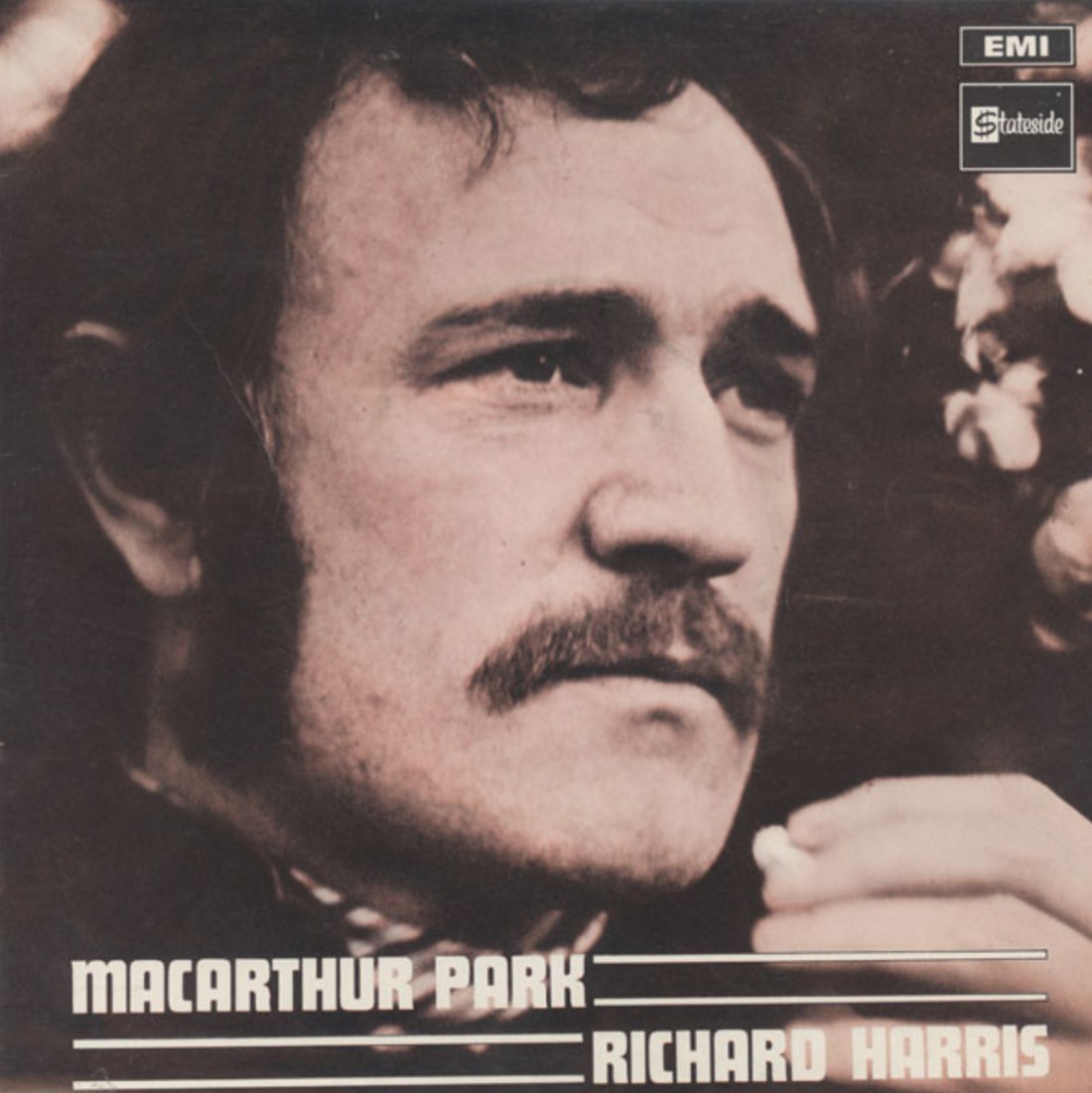
Richard Harris – MacArthur Park
Sometimes, a song can make such an impression that you can clearly recall a time in your life when you heard it playing. It might be the backdrop to your first kiss with your true love, or the soundtrack to a heartache (I’m going to do a whole series on those songs, just you wait), or just the theme to a great sports memory (I’m sorry Chicago Bears fans – in no parallel universe does “The Super Bowl Shuffle” count). What matters is the connection between how you were feeling and the song that was in the air.
And sometimes, you remember because you were confused.
I know exactly when I first really listened to Richard Harris’ take on “MacArthur Park”. At some point in 1982, CJCB ran a countdown of the Top 100 rock and pop songs of all time. I know it was 1982 because I was at that point under the delusion that John Lennon’s “Woman” might be the greatest song ever recorded – I had kissed a girl that I was crushing over badly while we slow danced to it, so my perspective was of course quite skewed – and I listened to eight-plus hours of great music only to end up, weirdly, disappointed. (That “Hey Jude”, a to my mind vastly overrated tune, was #1 did not help.) I don’t know who was polled to come up with this ranking, but it definitely was outside the mainstream. The oddest song that made it onto the list was probably “Vehicle” from The Ides of March, and I have no idea why that one in particular stuck in my head, but I’m glad it did. It’s a pretty good tune, but so little considered now that Acclaimed Music lists 222 songs from the year it came out in its top 10,000 tunes, and “Vehicle” isn’t one of them (though it is “bubbling under”).
Anyway, getting back to Harris, I knew his original had been a hit, and then there was Donna Summer’s smash disco cover from a few years earlier, but tracking down an older song was no easy task back then, especially if you were a teenager and, let’s be honest, didn’t really care all that much. (If me not having heard it seems unlikely to you, ask yourself how Sam Smith had never heard Tom Petty’s “I Won’t Back Down” before 2014 – and I happen to believe him – and then reconsider my position between 1968 (age: 4) and 1982.) So when I finally heard Harris’ take, I was – what? Dumbfounded, maybe. Perplexed for sure. This was a hit? This? How? Why?
Although he had starred on stage in “Camelot”, Harris wasn’t known as a singer, and I can’t say this recording really furthers any argument in his favour. Yet, in 1968, that’s exactly what he – with the considerable help of songwriter/producer Jimmy Webb – told the world he was, and the world said “Okay!” The song got to #2 on Billboard and earned him a Grammy nomination for Contemporary Pop Male Vocalist. (He lost to Jose Feliciano.) The album it came from, “A Tramp Shining”, was nominated for top album, along with Feliciano, The Beatles, Simon & Garfunkel and the winner, Glen Campbell. The category feels like a bit from “Sesame Street”.
This song shows up on some lists of the worst songs of all time, and I can only assume those people are not listening to it in the proper frame of mind. This is high camp, and while I have no way of knowing if that was Harris’ intention, I’m giving him the benefit of the doubt. He was a larger than life figure, and in more than a few of his film roles he leaned into the more foolish side of his character’s personality. (Plus, with no disrespect to the great Michael Gambon, he gave us the definitive Dumbledore.)
But leaving aside what Harris brought to the party, it’s simply a great song. There are three movements (making the world safe for “Paradise by the Dashboard Light”), the first being the baroque (thank you, harpsichord) moanings of a lovelorn troubadour. This blends into the gracefully balletic and contemplative second movement, before we get to the heart racing third movement, with the breathless pace of the theme song to a spy television show, or a stand-in for Supertramp on “W5”. Then we end with a call back to the first movement, with the big finish that sounds like the soaring choir at the curtain drop of a stage musical. And if all that isn’t enough, we have some of the most wackadoodle lyrics to ever grace the pop charts, like a poem from Shelley off his meds (in other words, just regular ole Shelley). Beautiful.
As weird as the song is – and for a pop song, it is mighty weird – you need only look at the heavyweights who have covered it to get a sense of its greatness: in addition to Summer, there’s Frank Sinatra, Tony Bennett, Glen Campbell, Waylon Jennings, Four Tops, and a bunch more. A lot of these are heavily edited, dropping a movement or two, none more so than the brisk 97 seconds of punk howl from The Queers, which makes things easier – for them, not us – by dispensing with any pretence of sounding like the song Webb wrote. My favourite might be the 1979 ska-esque version from Morgan Fisher under the names The Burtons and Hybrid Kids. The final results may vary, but what they have in common is an appreciation for the song’s scale and adaptability. It was an unusual recipe, but there is no denying that the cake itself is delicious.
 PopNotes