Classic Songs of My Youth Revisited #49

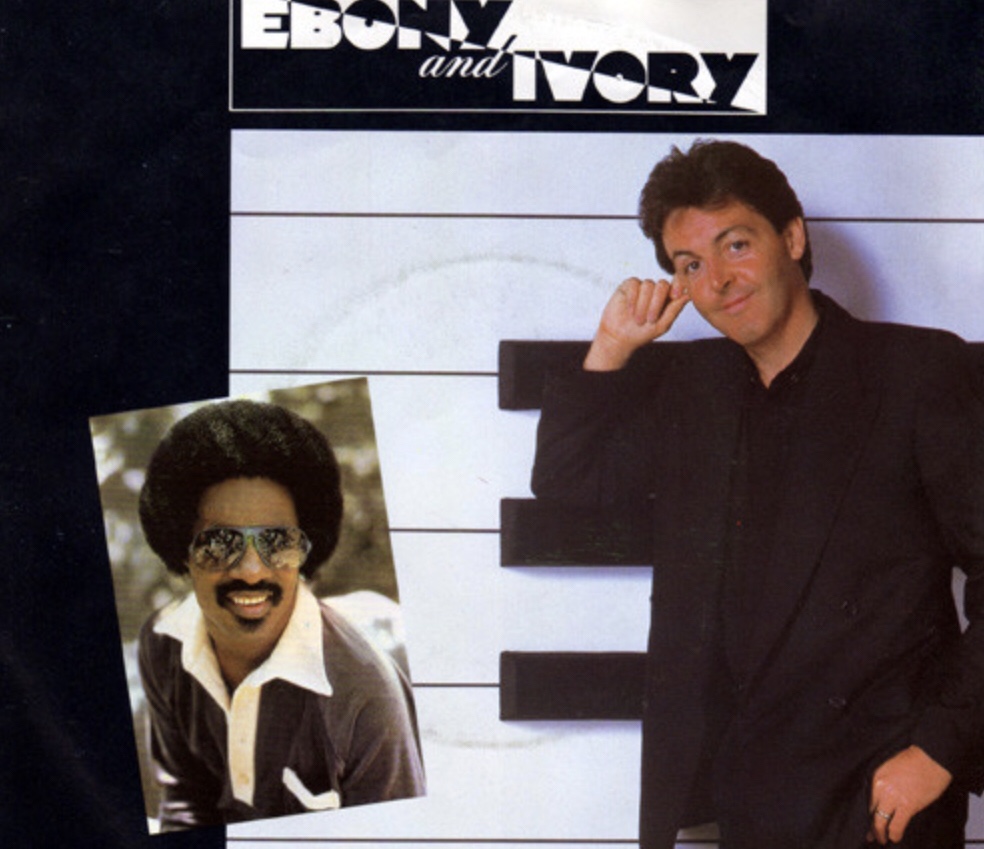
Paul McCartney featuring Stevie Wonder – Ebony and Ivory

It’s not surprising that our tastes change over time. When I was a teenager, I loved the novels of Irving Wallace. They were big books full of facts about fascinating topics: the Bible, the Nobel Prizes, American politics. Wallace was a capable but not particularly dynamic writer, and eventually I moved on to more challenging reads.

Those earlier loves can be enduring for nostalgic reasons even if our aesthetic sensibility no longer finds them pleasing as art. I recently listened to an album from The Ravyns, an early ‘80s band that had a minor hit called “Raised on the Radio” off the “Fast Times at Ridgemont High” soundtrack. The entire time it was playing, I just kept thinking that it was a perfect example of the overproduced faux rock of that era. I was trying to figure out what artist their sound most reminded me of, and then it hit me: Rick Springfield. Who I owned five albums by and listened to regularly into the early ‘90s without even once thinking that it might be shite. Who I still sort of love, but am now a little anxious about listening to very closely given my realization that his music may be sort of garbage and I think I’d rather not confirm that. Awareness can be a burden.

I mention all this because I am grappling with a question: why did 17-year-old me love “Ebony and Ivory”? Because 59-year-old me, and most intervening versions, wants all physical and digital traces of this song to be locked in a vault, dropped into Marianas Trench, have an anvil land on it Wile E. Coyote style and then blow the whole thing up for good measure. I don’t understand why we didn’t think it was awful at the time. I remember having a conversation about the song with my friend Alan Sutherland, who took his music very seriously, and he neither mocked it nor mocked me for liking it (and Al was always up for a good mock when circumstances called for it).

I had not really paid attention to it in years, and then suddenly there it was, in my poor ears, as the third track on a Paul McCartney compilation called “All the Best”. No, not even close to one of his best (though when “Silly Love Songs” also makes the cut, you know the bar is limbo champion low). Not when that record did not include “Helen Wheels”, “Maybe I’m Amazed” or “Mull of Kintyre”. Not when it could have been replaced by pretty much any omitted track from “Band on the Run”. No way.

So, why do I – the “there is no bad music” guy – think this song is so awful? First, is there a more treacly song out there? Yes, of course – the musical excrement that is “Butterfly Kisses” immediately comes to mind, and the name Bobby Goldsboro can give me hives. (I won’t link to them – if masochism is your game, you can easily find them yourself.) Neither of them, however, topped Messrs. McCartney and Wonder on Blender’s list of the 50 worst songs ever, where “E & I” ranked 10th. (“We Built This City” topped (bottomed?) the list, and I think everyone can agree – even, as it turns out, the woman who sang it – that it truly blows. (Aside: I just learned this was co-written by Bernie Taupin. How is such a thing even possible?))

Not a moment in the song isn’t sparkly clean, honed to a version of perfection that overlooks the part where a song should maybe be a bit dangerous to be actually fun. It’s all so artificial, a synth heavy soundscape that feels very lush, like lying in an aural down bed. There really isn’t much happening here: the only musically interesting bits are coming from Paul’s bass. It’s music for washing the dishes, not listening to, and thus is more akin to what is happening now than to an era where you still had to pay attention to the music coming over the air lest you miss something great and never have a chance to hear it again. “E & I” is musical wallpaper, and, like all wallpaper, if you look too closely you’ll notice the torn edges, the parts that don’t line up quite right and the soul crushing blandness of the thing. That’s this song in a nutshell.

I don’t doubt that Paul and Stevie believed in their message, limited as it may be to the confines of a chorus and a single repeated verse. The song’s notions about racial harmony were belittled on release as simplistic, and it’s not like another 40+ years of people trying to destroy each other on the basis of ethnic differences has redeemed their poptimism. But that never really concerned me: I knew exactly two Black people, and while race may have been something the two of them were highly conscious of, I wore blackface in our high school musical “Finian’s Rainbow” and never gave it a moment’s consideration. (I was 17 and living in a less enlightened time and place – the adults in the room maybe should’ve thought a little more carefully about the show they selected that year for a bunch of white kids to perform. Those photos could damage my political career!)

McCartney and Wonder made tons of music that I love, but very little of it came after this team-up: Stevie’s last widely acclaimed album was 1980’s “Hotter Than July”, and some feel this song marked the point where Paul began to lose credibility as an artist. You have to give them credit for one thing: it takes a lot of confidence to make a record this earnest, although no one ever went entirely wrong recycling lame messages about humanity’s inherent goodness. The lyrics were made for a United Nations banner, not the top of the charts, yet somehow that’s where they ended up. I guess we were just really boring in 1982.

SoundTracking #1

“Bond . . . James Bond”

I love James Bond movies, and there is nothing quite like a classic Bond theme song. The best of them tie the familiar John Berry motifs from the score to a pop sensibility that sounds fresh while holding lingering echoes of another era. They feel both of the ‘60s when Bond first stepped onto our screens, but also very much of the moment when a given film was released. 

There really isn’t any sort of consensus about the “best” Bond song, though there are certain tunes that are consistently high on individual lists. This is my personal top 5 – and, no, it does not include Adele.

No. 5 – Carly Simon, “The Spy Who Loved Me

The first Bond song that I knew of in real time, I finally saw the movie about a year ago and was floored by what an epic cheese fest it is. The song matches it, step by step, Gruyère by Parmesan. From swelling strings, heavily-banged-on piano keys and that guitar sound that was endemic to ‘70s AOR tracks, you could easily dismiss this as pop pap. Yet, what saves it, what elevates it to art, is Carly’s measured vocal, the straightforwardness of her declaration about the man the singer loves but really doesn’t trust (he is not just a spy after all, but THE spy). The song as written isn’t worthy of her, but she redeems it anyway.

No. 4 – Duran Duran, “A View to a Kill

The Roger Moore Bond flicks were often barely watchable within a year or two after their release (see above re “The Spy Who Loved Me”), and this was easily the worst of the lot. Other than Grace Jones being in it and this song, I remember zilch about “A View to a Kill”, the motion picture. And when it came out in 1985, I was to that point generally unimpressed with Duran Duran’s contributions to the music world. (That’s evolved over time – “All She Wants Is” is an all-time favourite tune, and those old singles always give me a jolt of nostalgic pleasure.) But this song grabbed me right away – I bought the 45 – with its mix of second British Invasion new wave pop and retrograde funk. The lyrics are completely nonsensical, which adds to the fun.

No. 3 – Sam Smith, “Writing’s on the Wall” (from “Spectre”)

Have you ever hated a song at first, then slowly grown to love it, and maybe love it more for the journey? That’s this song. And the journey is even more noteworthy for the song having been chosen over a hauntingly beautiful and sort of terrifying Radiohead tune. Somehow, this song sums up everything a Bond ballad should be – sensual, epic, vivid and, yes, a bit over-the-top. If you don’t get chills when this plays, you need to see a neurologist, because something in your nervous system isn’t working properly.

No. 2 – Paul McCartney, “Live and Let Die

So, here we are: the alpha and omega of Bond theme songs, it falls to no. 2 only for the more contemporaneous nature of my experience with the song listed below. Obviously, McCartney knows how to write a great pop song, and this doesn’t let you down. (I was going to make a rude comment about it losing the Oscar in 1973, but having just listened to “The Way We Were” for the first time in about 500 years, I have to admit it’s a pretty potent record, even though the only part of it worth saving for posterity is Barbra’s vocal – the rest gives 1970s cheese a bad name. Hmm, I guess I have made a rude comment.) He changes tempo about 86 times, and, like a great Bond movie, it’s a thrill just to try and keep up. Killer Guns N’ Roses cover, too.

No. 1 – Chris Cornell, “You Know My Name” (from “Casino Royale”)

It’s hard to top McCartney, but Cornell does it for me. Daniel Craig is my utopian ideal of what Bond should be – pity the poor bastard who is going to replace him sometime soon – and I have loved the movies (yes, even “Quantum of Solace”). After a cold open that establishes how Bond earned his 00 status, we are thrown into the title sequence. Cornell truly had one of modern rock’s great voices, and him showing up here tells the viewer, if the black-and-white opening didn’t make that clear, that this is not your dad or older brother’s Bond. It’s gritty, and loud, but that voice, that magnificent howl, reveals the grace and poetry that will also follow. The lyrics, too, are ruthless, a window into the soul of a (possibly) irredeemable killer. Now, after five films, with Bond having (spoiler alert) made the ultimate sacrifice, the song feels even more potent for showing the “blunt instrument” (Judi Dench rules) who grew into the man who saved the world and, finally, himself.

Not the Pazz and Jop 1973 #13

Paul McCartney & Wings – Band on the Run

The Beatles were the first band I loved, so I can’t really say why I had so little interest in their solo work. I definitely want to blame one of my younger uncles – I can’t remember which one, so all are both tarred and unsullied by this comment – who said we couldn’t play his Beatles records anymore after they broke up. I usually liked their singles that I heard on the radio, but only bought two of their records: a 45 of John Lennon’s “Imagine” years after it was released, and George Harrison’s “Somewhere in England”, which I wanted for his John tribute “All Those Years Ago”. Later, I owned Paul McCartney’s “Flowers in the Dirt” on cassette, but that arose not out of fealty to Paul but because I wanted to hear what his collaboration with Elvis Costello had wrought.

Over the past year, I’ve started to make up for this lack. It turns out “Somewhere in England” is not a very good record, but George’s “All Things Must Pass” is brilliant. John’s “Imagine” annoyed me immensely but I was floored by “Plastic Ono Band”. Ringo Starr’s “Ringo” was a frothy delight. And now, we come to Paul.

I had measured expectations coming in. As a solo artist. Paul always felt to me as someone who too often accepted mediocrity. For every great single (“Live and Let Die, “Band on the Run”, “Let ‘Em In”), there would be treacle (“Silly Love Songs”), silliness (“Coming Up”), or whatever we want to call the utter abomination that is “Ebony and Ivory”. And that Costello collaboration? Meh.

So my absolute joy over this album is beyond reason. I won’t call it perfect, but there isn’t a skippable track here, and that’s the next best thing.

“Band on the Run” has always kicked ass, and I have a new appreciation for “Jet”. But what’s really fun about listening to an album like this is discovering songs you never even realised existed. Why isn’t “Bluebird” a staple of easy listening radio? It’s a wistful and delicate love song with a jazzy horn break and an air that is so tropical you can almost feel the warm breeze. “Mamunia” has a similar feel, but more uptempo so that you’ll be bobbing your head in pace with the music by the end. I love the guitar in the chorus to “No Words” and the rollicking piano of “Nineteen Hundred and Eighty Five”, which ends with saucy horns before sending us off with a snippet from the title track. And the old-timey “Picasso’s Last Words” is probably the most Beatlesesque track, the kind of song that manages to be both simple sounding and pretentiously complex at the same time.

The standouts for me are “Mrs Vandebilt” and “Let Me Roll It”. The former is a bouncy romp (kitchen dancing!) that is the most fun song here, with the “ho hey ho”s of the chorus and snappy horns. (The cackling at the end was sort of creepy, though.) The latter has my favourite vocal on the record – an impassioned and committed tear through the song, joined by uncomplicated guitar work that cuts through you and pairs well with the emotion in the singing. My favourite moment comes with the addition of subtle bass picking and light snare drum leading up to the three-minute mark, which filled me with delight.

If there is one trend in these listening sessions, it’s learning, week after treacherous week, that I formed some flawed ideas about music earlier in life and, despite my belief that I am open to the new, I am as stuck in my listening patterns as the next guy. With every new record, I am taught anew that I need to try to abandon expectations before hitting “Play”. Today, it’s Paul McCartney. Others will soon follow, I’m certain.