
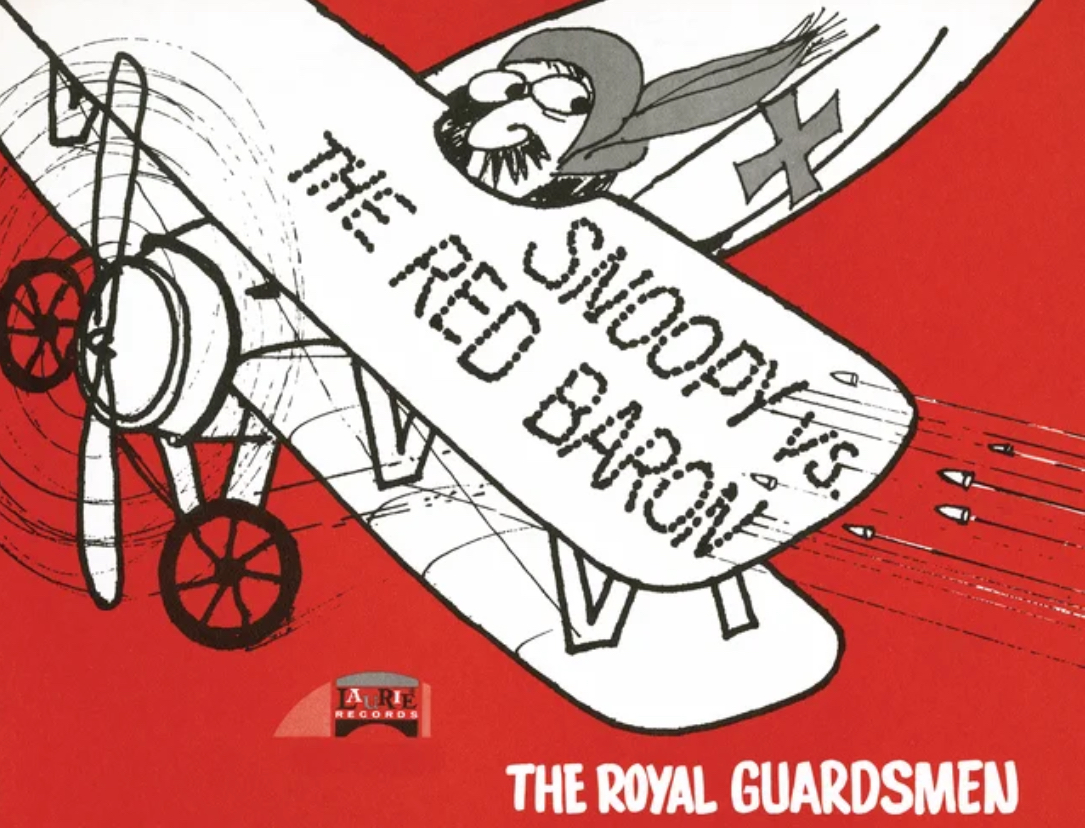
The Royal Guardsmen – Snoopy vs. the Red Baron
The 1960s was probably the era in musical history that the word “goofy” can best be applied to. It was the glory days of the novelty song, when a weird record might be followed by an even weirder record, and none of this weirdness could stop both of them from climbing into the upper reaches of the singles chart. This included acts like The Singing Nun and The Irish Rovers – just those names tell you something about what you’re going to be listening to – but these were mere glimpses of the nuttiness of those years. There was Larry Verne’s “Mr. Custer”, which might get him cancelled today, with “Injuns” and “redskins”, whoops and scalping. The Trashmen’s gloriously obnoxious “Surfin’ Bird” (which wears out its welcome about 30 seconds in), The Hollywood Argyles’ comic strip-inspired “Alley Oop”, and other oddballs like “Simon Says” and “Yummy Yummy Yummy” were all hits. Ray Stevens made a career out of novelties, with two songs that I can recall the lyrics to today almost in their entirety in “Ahab the Arab” and “Gitarzan”. Even some acts that were very serious about the music they were making, like The Monkees, had a decidedly non-serious image.
Novelty songs didn’t have much staying power on radio, as listeners would soon tire of them and move on to the next strange thing. Luckily, for a child in the 1970s, there was K-tel. The discount record label would, as it did with all the popular music it could get hold off, repackage these tunes in collections of 20 tracks, and deliver them to our ears with teasing television commercials that lured us to the bins and racks of our local record store. My family owned several of these compilations, but the only one I can remember by name is “Goofy Greats”. The tracks listed above save “Gitarzan” were included, along with a dozen-plus more. And starting it off, in keeping with its cultural might, was The Royal Guardsmen and “Snoopy vs. the Red Baron”.
Snoopy, of course, is the pet beagle of Charlie Brown, the protagonist of the “Peanuts” comic strip. Like most kids of that era, I would read “Peanuts” and other comics in the daily paper, skipping over more adult offerings like “Mary Worth” (while also bemoaning the space being wasted on them), and my family’s book offerings included some paperback collections of older strips. Snoopy was the breakout, the supporting character who became the real star: the Steve Urkel of his day. He had a rich interior life full of bold adventures, sometimes accompanied by his bird friend Woodstock. And most prominent of these was his long-running feud as a World War I fighter pilot with the dastardly German flying ace, Manfred von Richthofen, a.k.a. the Red Baron. So, in the spirit of the era, it was logical for the writers of a tune about the Baron to add some new lyrics – the inevitable litigation to come be damned – after failing to capitalize on the vogue for historical songs to try and instead take advantage of this helpful new attention being paid to their very old subject. That lawsuit meant that the songwriters had to give up the publishing revenues from the tune, but the song got out into the world, and eventually hit #2 on Billboard, losing out on the top spot to the non-novelty Monkees and “I’m A Believer”.
The song is definitely worthy of the label “goofy”. There’s lots of psychotic-sounding German – the opening spiel calls Snoopy pig-headed – along with machine gun fire and the sound of airplanes falling out of the sky. Snoopy, after initially failing to take out the Baron, consults with renowned military strategist the Great Pumpkin (Linus is redeemed!), forms a plan and shoots down his foe, stealing glory from the soldier – whose identity has never been definitively agreed upon, but may have been a Canadian pilot – who actually did the deed. The backbeat feels like a sped-up march, and there’s a pseudo sample of “Hang on Sloopy” that almost resulted in a second bit of litigation for this little tune. Musically, there is nothing much happening here, but it has the virtue of a taut narrative: it just races through the entire tale in a crisp 2:40. That precision has another benefit: you can listen to it several times in a row without wanting to throw yourself out of the nearest Sopwith Camel in mid-flight.
This is possibly the greatest novelty tune of all time for several reasons. First, The Royal Guardsmen didn’t just disappear like so many bands after their moment of oddball chart glory passed: they later had some minor non-novelty hits, and with some interruptions and changes in personnel, remained a functioning act as recently as 2011, and possibly beyond. Second, it spawned numerous (and occasionally successful) sequels, including “Snoopy for President” (my wife owned the album), “Snoopy’s Christmas” and the absolutely nutbar 2006 release “Snoopy vs. Osama”, in which our beloved beagle seems a tad bloodthirsty (while suggesting that “Zero Dark Thirty” is as true a tale as the Apollo moon landing). Third, the song itself has had surprising longevity: Quentin Tarentino even used a snippet in “Once Upon A Time in Hollywood”. Finally, and most importantly, there are covers: in Spanish, Italian and Finnish, and ska and punk-ish versions, too. The last two are kind of fun, but the others are just the same song in a different language. But that, too, is a triumph because someone thought it was worth the trouble to do that.
There is, however, a clear winner for the weirdest version of this song. Fearful of litigation, the Canadian arm of The Royal Guardsmen’s record label refused to release it as written, so the band re-recorded it with new lyrics under the name “Squeaky vs. the Black Knight”. It actually got some traction on Canadian airwaves before the legal issues were sorted out and the original began its journey to becoming the most popular song in the country. The song is identical in almost every way but for a few changes in the lyrics, but those changes make it completely nonsensical, entirely detached from any context that would help you enjoy it: only here can you find a buck-toothed beaver keeping the skies over Europe free from German tyranny. It’s a true novelty song: horrible, but not so horrible that you won’t be tempted to hit “repeat” at least once to make sure of what you thought you heard.
 PopNotes